Quick answer
To monitor retailer prices, list the resellers carrying your products, collect one product URL per reseller, then track those pages on a fixed schedule with alerts on deviations from your recommended price. Competiprice automates the collection and keeps the history brands need to document repeated breaches.
Monitor your retailers
Centralise your retailers’ URLs and detect significant gaps without manual monitoring.
Test 3 URLsWhen a brand sells through a network of online retailers, one question quickly arises: are some partners discounting so aggressively that they damage the brand’s positioning, the network’s margins or other retailers’ confidence?
The answer is not to monitor prices in order to impose them. It is to build factual monitoring: which retailers sell which products, at what price, how often, with which promotions and in what commercial context.
Important: in France and the European Union, a supplier must be extremely careful about resale prices. Observing market prices is a useful practice. Directly or indirectly imposing a resale price can expose a business to competition-law risk. This article is not legal advice, but an operational framework for working responsibly.
Why suppliers should track retailer prices
An unusually low retailer price can have several causes: a one-off promotion, inventory clearance, a pricing error, high shipping costs, an older-generation product, a marketplace listing, a promotional code or a genuinely aggressive strategy. Without regular collection, these situations become indistinguishable.
For a supplier, price monitoring is first and foremost a way to understand the market and bring objective evidence into conversations with the retail network. It helps answer three questions:
- Which retailers frequently depart from the usual positioning?
- Are the gaps one-off, seasonal or permanent?
- Do the reductions affect a few sensitive references or the entire catalogue?
The line not to cross: resale price maintenance
The European framework distinguishes market monitoring from practices that restrict a distributor’s freedom to set prices. The European guidelines on vertical restraints address resale price maintenance, recommended prices and maximum prices, among other topics.
In practice, a supplier can generally publish a suggested or recommended price, provided it does not become an imposed price through pressure, threats, penalties, delivery delays, withdrawal of benefits or an incentive scheme that effectively makes the price mandatory.
Monitoring must remain a tool for observation, analysis and documentation; it must not be used to turn a recommended price into a mandatory pricing instruction.
What you should monitor in practice
The right approach is not to police the entire internet. Start with a limited but reliable scope. For each priority reference, track the main retailers and the channels that genuinely influence price perception.
- Strategic references: bestsellers, new products, high-margin products and brand-defining products.
- Priority retailers: official partners, high-traffic websites, marketplaces and specialist online retailers.
- Displayed price: price including tax, struck-through price, promotion, availability and visible shipping costs.
- Context: low stock, sales, clearance, commercial campaign or older reference.
- History: frequency of gaps, duration of promotions and repetition by retailer.
The five-step method
1. Define the sensitive scope
List 20 to 50 references where aggressive discounting creates a genuine problem: brand image, retail-network margin, product launch, conflict between retailers or cannibalisation.
2. Link retailer URLs
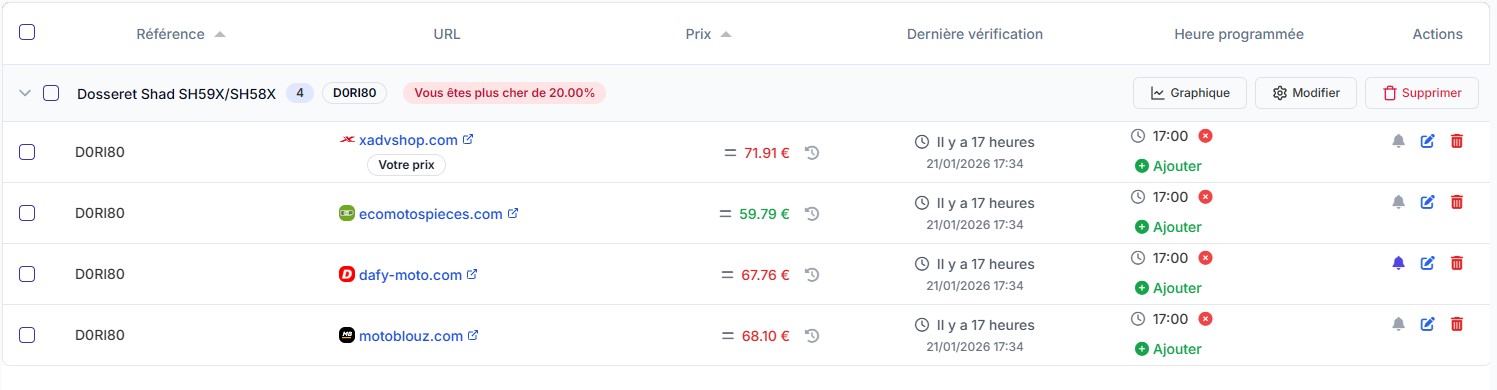
For each product, link the URLs of the retailers you want to track. The objective is to create a stable foundation: the same reference, the same page and the same channel. This is what enables accurate comparisons later.
3. Collect regularly
Weekly collection is rarely enough for sensitive products. Daily collection, or even several collections per day during major commercial periods, makes it possible to identify short-lived reductions and flash promotions.
4. Qualify the gaps
Do not flag every gap of one or two per cent. Configure internal analysis thresholds that are not communicated as pricing instructions: for example, a gap above 10%, an unusual change, a repeated reduction lasting more than 48 hours, or a retailer that is consistently cheaper than the rest of the network.
5. Document before making contact
Before speaking with a retailer, retain the data: date, URL, price, availability, a screenshot if necessary, and the history. This prevents discussions from being based on an impression or an isolated screenshot.
Examples of useful alerts for a supplier
- A gap exceeds an internal analysis threshold used solely to prioritise checks.
- A new product is heavily discounted less than 30 days after launch.
- A retailer remains 15% cheaper than the network median for more than 48 hours.
- A marketplace displays a very low price for a strategic reference.
- A price falls sharply while the product is shown as available.
These alerts do not automatically mean that action should be taken on the price. They mean the context must be checked: inventory, promotion, error, older model, delivery terms or contractual situation.
How to use the data without creating unnecessary risk
Price monitoring should be presented as a market intelligence and management tool. It can inform sales, marketing, category management and e-commerce teams. It must avoid wording that resembles a pricing instruction.
- Prefer: analysing gaps, understanding their causes, detecting inconsistencies and checking compliance with non-price quality standards.
- Avoid: asking a retailer to raise its price to a given level, threatening a penalty for low prices or making benefits conditional on adherence to a price.
- Set a framework: internal and commercial discussions must remain factual, dated and understandable to an outside observer.
To structure this process, you can also read our pages on competitor price monitoring, e-commerce price monitoring and competitor price alerts.
What Competiprice provides
Competiprice lets you centralise retailer URLs, collect prices, track history and receive alerts whenever a situation warrants investigation.
For a supplier, the benefit lies in moving from scattered manual monitoring to a factual dashboard: sensitive products, monitored retailers, gaps, history and priorities.
- Retailer URL monitoring by product.
- Price history to distinguish one-off promotions from trends.
- Threshold- or change-based alerts.
- A centralised view for preparing commercial reviews.
Useful official sources
To understand the framework, consult the French Competition Authority’s competition guide for small businesses, the European Commission page on vertical agreements and the French consumer and competition authority’s guidance on resale below cost. If you are unsure about your commercial policy, have your practices reviewed by a specialist adviser.
Conclusion
Monitoring online retailer prices is good practice for a brand or supplier. But the purpose must remain clear: understand the market better, protect the consistency of the network and identify situations that require analysis.
The best method is straightforward: monitor a priority scope, collect regularly, qualify the gaps, retain a history and remain careful about how the data is used commercially.