Quick answer
To monitor competitor prices in e-commerce, start with your 20 to 50 most sensitive references, attach three to five competitor URLs to each, then schedule a daily collection with alerts on price drops. Competiprice automates that collection and stores the history you need to decide without reopening every product page.
Reading time: 8 minutes
You run an online store and know that monitoring your competitors is essential. But between managing inventory, answering customers and optimising marketing campaigns, you waste an enormous amount of time visiting every competitor website, every week or even every day.
For a small e-commerce business, the challenge is even greater: less time, fewer tools and direct pressure on margins. The objective is simple: automate repetitive work.
This monitoring task is often skipped because there simply is not enough time. That is when it becomes a genuine headache: you discover too late that a competitor has reduced its prices, and you have lost sales.
In this guide, you will learn how to move from manual checks to automated competitor price monitoring, with a clean URL database, a suitable frequency and actionable alerts.
Why manual price monitoring does not work
The time problem
The reality of manual competitive monitoring is simple: it is time-consuming.
Imagine that you track 10 competitors with 50 products each. That represents 500 URLs to check regularly. Even if you work quickly and spend only 30 seconds per product, it takes more than four hours each time.
If you do it every week, that means 16 hours per month lost to a repetitive task.
Human error
When monitoring is performed manually:
- Some products are forgotten
- Prices are recorded incorrectly
- Subtle changes go unnoticed
- Price history is lost
A spreadsheet can help you get started: our free price comparison Excel template includes a worked example, shipping costs and automatic price differences. As the number of products and competitors grows, keeping those prices up to date becomes the main challenge.
Timing
The worst part? You discover price changes too late.
Your competitor reduces its prices on Monday morning. You only discover the change on Friday during your weekly review. In the meantime, you have lost five days of potential sales.
The three pillars of effective competitor monitoring
For your price monitoring to work effectively, you need three things:
1. Organisation
Organisation is the foundation. You need to:
- List your priority competitors — there is no need to monitor 50 websites if five represent 80% of your market
- Identify the key products to monitor first
- Structure your data so you can navigate it easily
My advice: start small. Begin by monitoring your 20 to 30 flagship products across three to five main competitors. You can expand later.
2. The right tools
Using the right tools makes all the difference. Move beyond Excel and manual checks: you need automation.
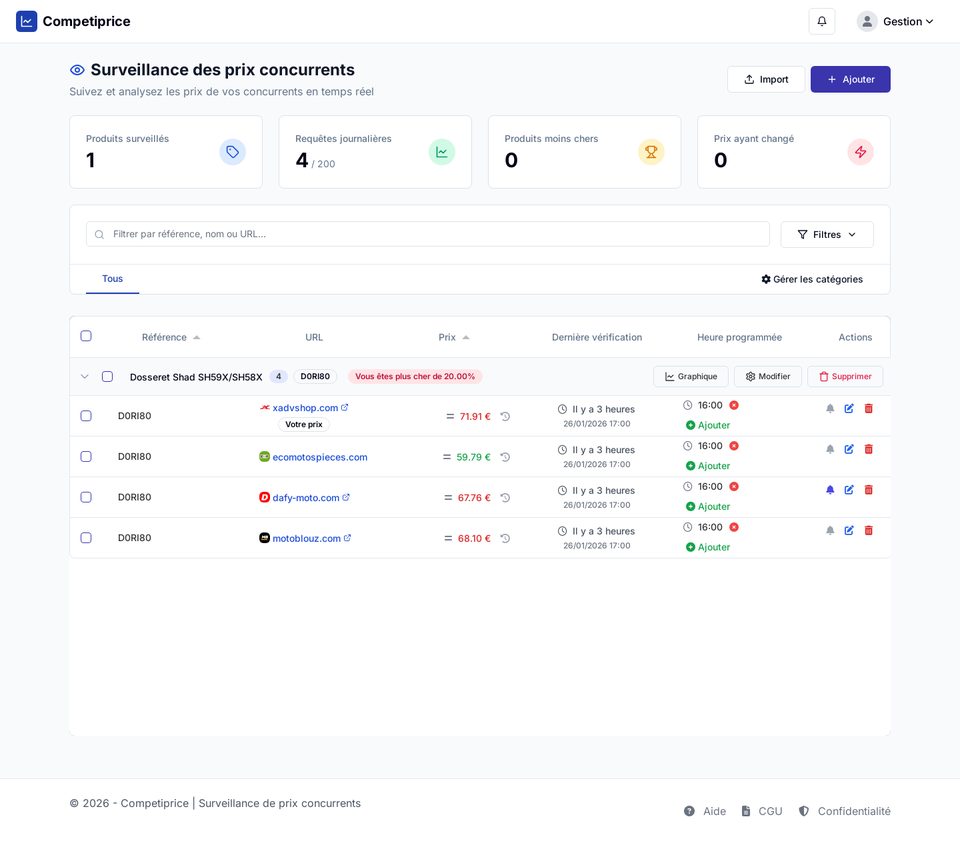
A good price monitoring tool should enable you to:
- Collect prices automatically
- Alert you when a change occurs
- Retain price history
- Visualise the data easily
3. Consistency
Price monitoring is like exercise: 10 minutes every day is better than two hours once a month.
The ideal setup is automatic daily checks that let you:
- Detect changes quickly
- Respond before your other competitors
- Build reliable history
How to set up your automated monitoring system
Now for the practical part. Here is how to automate competitor monitoring in a few straightforward steps.
Step 1: Gather your URLs
Start by listing all the competitor product URLs you want to monitor.
There are several methods, depending on your situation:
If you are starting from scratch:
- Browse competitor websites
- Copy the URL of each product you want to monitor
- Organise them by competitor or category
If you already have an Excel file or Google Sheet:
- Perfect — you can import it directly
- Make sure you have a column containing the complete URLs
- Add columns for classification, such as competitor and product category
If you have a large number of products:
- Prioritise your bestsellers and high-margin products
- Use CSV import to save time
Step 2: Configure your monitoring tool
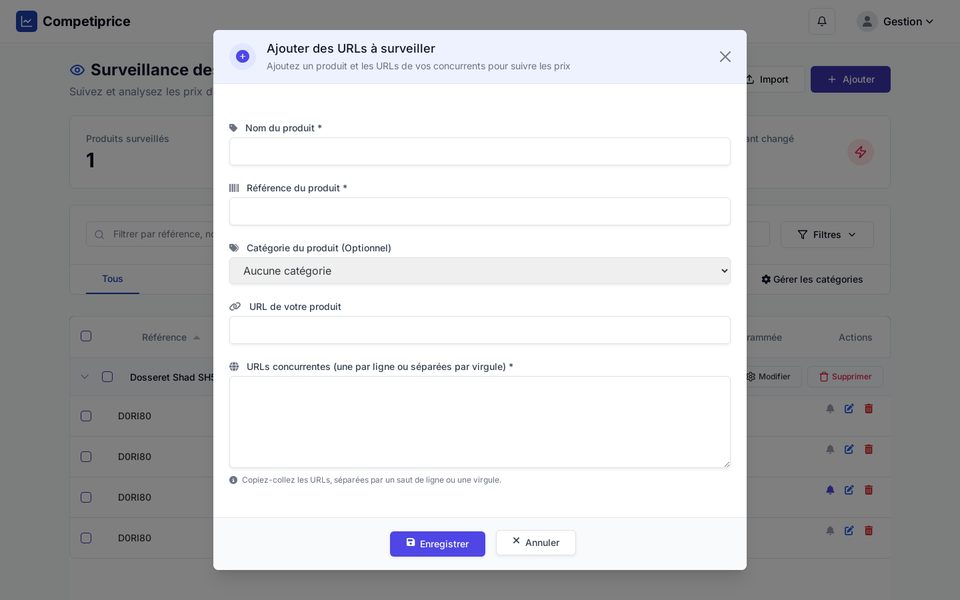
Once your URLs are ready, you need to add them to an automated monitoring system.
Three ways to add your URLs:
- Add products manually, one by one: ideal for getting started or testing
- Bulk import by copying and pasting: perfect when you have a list in a document
- CSV import: for high volumes involving hundreds of products
It is important to organise your products properly from the outset. You can classify them:
- By competitor
- By product category
- By priority, using A, B and C according to importance
Step 3: Define the monitoring frequency
Not every product requires the same checking frequency.
Highly price-sensitive products, such as electronics and technology:
=> Check daily, or even several times per day
Medium-turnover products:
=> Two or three checks per week are enough
Niche or slow-moving products:
=> Once a week
My advice: begin with a daily check for all products over two or three weeks. This will give you an idea of price volatility in your sector.
Step 4: Configure your alerts
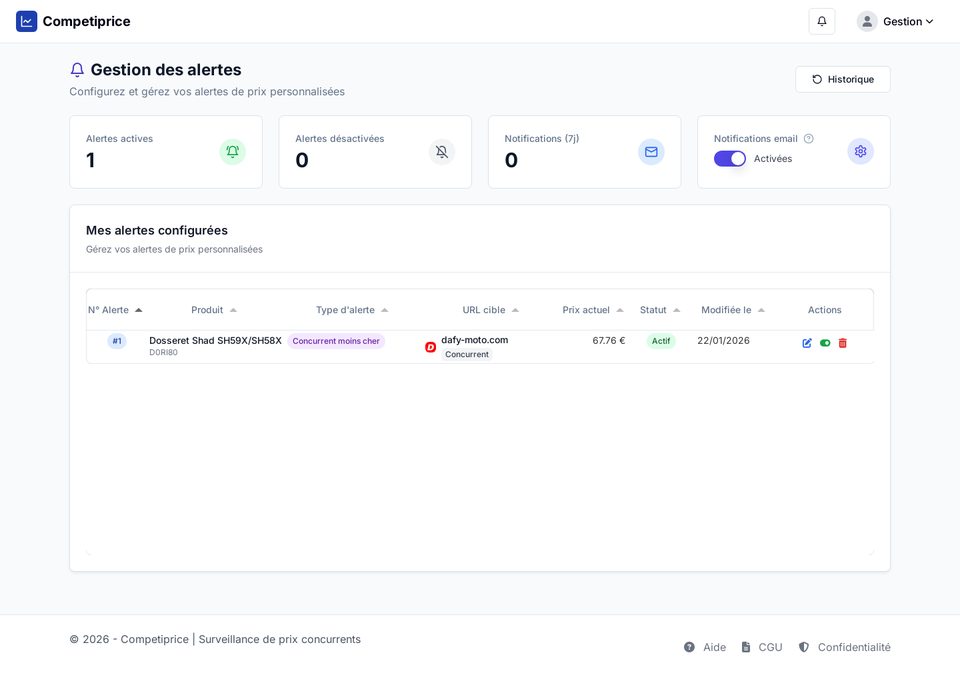
This is where the magic happens. Instead of checking manually, you are notified automatically when something changes.
Useful alert types:
- A competitor reduces its price: you can respond quickly
- A competitor becomes cheaper than you: receive an alert when you are no longer competitive
- A target price is reached: for example, “notify me if product X falls below EUR 50”
Configure alerts intelligently: too many alerts create noise, while too few mean missed opportunities.
Step 5: Analyse and act
Monitoring only makes sense when it leads to practical action.
Questions to ask regularly:
- Which competitors adjust their prices most often?
- Are there time-based patterns, such as reductions at weekends or increases at the start of the month?
- Which products are consistently more expensive on your store?
- Where can you safely increase margins?
Possible actions:
- Tactical adjustment: align your price with a specific competitor
- Margin optimisation: increase the price if every competitor is more expensive
- Targeted promotions: compete on products where you have an advantage
- Repositioning: if you are always more expensive, you may need to justify that through added value
Mistakes to avoid in price monitoring
Mistake 1: Monitoring too much from the outset
Start small and do it well instead of starting large and doing it poorly. It is better to monitor 30 products effectively than 300 approximately.
Mistake 2: Having no response process
Monitoring without action is wasted time. Define in advance:
- Who analyses the data?
- Who decides on price adjustments?
- What is the procedure when an alert is triggered?
Mistake 3: Blindly copying competitor prices
You do not need to be the cheapest everywhere. Sometimes a competitor harms its own business with prices that are too low. Analyse before following: a 10% discount can require 50% more sales (see how a discount affects your margin), and in France, selling below cost is prohibited except in specific cases.
Mistake 4: Forgetting the context
A displayed price may or may not include:
- Shipping costs
- Temporary promotions
- Promotional codes
- Return conditions
Consider the complete offer, not just the number. A strikethrough price only makes sense against the price of the previous 30 days (the 30-day rule), and two stacked discounts do not add up (successive discounts).
The practical benefits of automated monitoring
Time savings
Instead of four hours per week, you spend 15 minutes analysing the data. That is a saving of 15 hours per month that you can reinvest in your business.
Responsiveness
After scheduled collections, you are alerted whenever a change matches your rules. You can adjust your prices faster instead of discovering movements a week late.
Margin optimisation
With an accurate understanding of the market, you can:
- Increase margins on products where you are underpriced
- Adopt aggressive pricing on strategic products
- Identify references where a higher margin appears possible without losing competitiveness
Data-driven decisions
No more adjustments based on gut feeling. You have accurate data to justify every pricing decision to your team or investors.
How Competiprice can help
At Competiprice, we have designed a solution that fully automates this monitoring. Our tool:
- Detects prices on many accessible product pages, with no installation required on your store
- Collects prices according to the checks per day included in your plan
- Alerts you after collection when a configured rule is triggered
- Retains complete history for analysing trends
- Supports bulk URL imports through copy and paste or CSV
You can start for free with our Discovery plan — five products, three competitors per product and one collection per day — to test the tool with no commitment.
Conclusion: take action today
Monitoring competitor prices is no longer a luxury: it is essential for remaining competitive in e-commerce.
The good news is that you do not need to spend hours on it. With the right tools and clear organisation, you can automate repetitive collection and focus your time on analysis.
Your action plan for this week:
- List your five main competitors
- Identify the 20 to 30 key products to monitor
- Gather the URLs in a file
- Test an automated monitoring tool such as Competiprice
- Configure your first alerts
Effective competitor monitoring is like having a virtual assistant working for you around the clock. Stop wasting time on manual checks: automate and focus on what genuinely matters — growing your business.
About the author: Creator of Competiprice, an automated competitive monitoring solution for online retailers. Passionate about optimisation and automating repetitive tasks.
Did you enjoy this article? Share it with other online retailers who could benefit from it!